
Trauma – 6 sources, 6 impacts

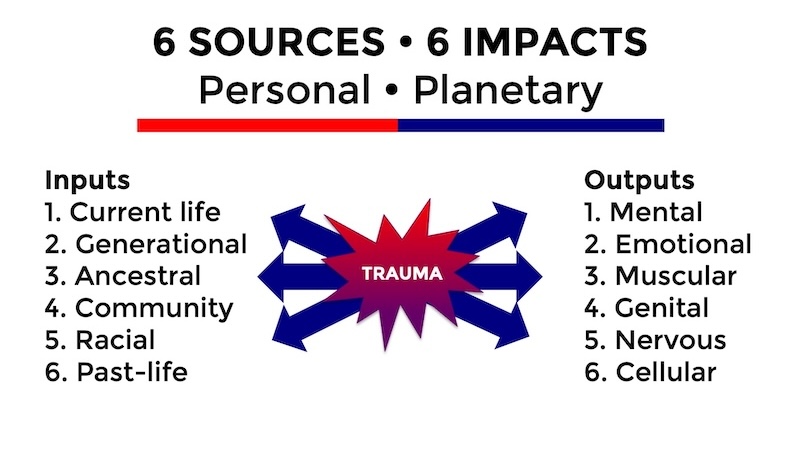
Some people collect butterflies. Matchbox cars. Stamps. I’ve been chasing down a systemic catalogue of trauma’s sources and impacts for some years.
Sources of trauma
In 2018 I wrote a blog (since deleted) titled ‘The 3 layers of trauma – ancestral, generational, current-life,’ in which I ascribed all trauma to one of those categories. After the 2021 Intergenerational Trauma Conference (ATC) my view became more nuanced.
In a blog titled Trauma exists as a series of ripples I added two more layers—racial and community trauma—but, perhaps more importantly, saw the way all the different layers interpenetrated and rippled through each other.
I have, slightly reluctantly, settled on six. The final layer is past-life trauma. I’ve been processing it for over half a decade yet stayed silent—until now. I felt inherited trauma was enough of a stretch for many people and past-life trauma just seemed daft. Yet I cannot ignore the impact it’s had on my life, and the incompleteness of the list rankled too much.
Here are brief descriptions of each source:
1. Current-life trauma
Current-life traumas are emotional wounds (and the coping mechanisms to manage them) acquired over the course of our lives. These range from high visibility, high impact traumas such as a messy divorce to low visibility—though not necessarily low impact—traumas.
For example, I grew up in a house with an angry father, which created a continuous sense of imminent, though not necessarily actual, danger that was ultimately traumatic.
2. Generational trauma
All inherited traumas can be described as generational trauma or even ‘family trauma’ as we inherit it from our parents. Yet not all of this comes from events that happened to them.
Here I use the term ‘generational trauma’ to describe traumatic events that happened to the most recent 2 to 4 generations of our families. Events like divorces, sex scandals, financial failures, or war experiences that were too traumatic to handle. The shame and pain of these events are experienced as if they happened to us.
3. Community trauma
The next source layer is community trauma. This is trauma that affects an entire community. Peter McBride, Director of the Cohen Center for Holocaust and Genocide Studies, spoke at the 2021 ITC about community trauma in Northern Ireland. As time goes on, the source of a trauma becomes less evident. “Communities can eventually ‘forget’ or minimise the source of their trauma, while still exhibiting their embedded trauma identity,” says McBride.
Other examples of community trauma include India’s caste system, Korea’s Han, America’s Wild West gun culture, and the schism between Sunni and Shia Muslims.
4. Racial trauma
At ITC 2021, Professor Kenneth V. Hardy noted racial trauma “is a by-product of perpetual exposure to oppressive conditions”. It is “hardly ever acknowledged, almost never named… When a phenomenon is not named, it is not acknowledged; when it is not acknowledged it is not considered legitimate; when it is not considered legitimate, it’s hard to treat.”
“There’s a value in naming racial trauma,” says Hardy, because we avoid naming it to avoid dealing with it. The same is true of all traumas, though the deeper and the more widespread the trauma, the greater the reluctance to acknowledge it.
5. Ancestral trauma
The term ancestral trauma refers to unprocessed traumas arising from the dawn of the patriarchal age that have been handed down through epigenetic inheritance ever since.
Ancestral trauma is a significant driver of toxic masculinity. For thousands of years, male violence was socially glorified. Male sexuality was expressed through the violent conquest of wives, mistresses and the enslavement of their defeated enemies’ womenfolk.
The psychological legacy of our patriarchal past has never been fully acknowledged, accepted and healed. It surfaces today in various forms, including BDSM practices and an attraction to pornography depicting the subjugation and exploitation of women.
6. Past-life trauma
These operate very much like generational trauma—except that we have no family tree or memory bank of family stories from which to piece together the details. We may have some inner sense of these lives and their events, or information may come to us externally through people with clairvoyant abilities.
Confirmation can also come from external events, up to and including physical signs such as bleeding in specific places at specific times that relates directly to the trauma. I’ve had all these experiences, repeatedly and with incredibly systemic precision.
Obviously, this trauma layer contains the potential for delusion, particularly where historical personalities are involved. It’s not important whether the past life truly existed. What matters is its impact on your current life. If you can treat it using the mechanical principles of trauma and relieve the symptoms, that’s proof enough that whatever you worked through had some basis in fact.
Impacts of trauma
I first attempted to catalogue the impacts of trauma in a 2020 blog titled The emotional cost of generational trauma. What I now see is that the impacts extend way beyond the emotional sphere.
Conveniently, the impacts also seem to affect us at six levels:
1. Mental
Psychiatrist R. D. Laing writes that, “When our personal worlds are rediscovered… we discover first a shambles… genitals dissociated from heart; heart severed from head; heads dissociated from genitals.” [1]
The critical thing to recognise is that we’ve largely lost connection with our hearts and genitals. We’ve also lost connection with our musculature, nervous system, and cells. We’re left to operate from the mental sphere of our lives as if it were the totality of life.
This heavily skewed, mentally dominated existence is called hemispheric dominance. From this numbed-out place we can’t feel how traumatised the rest of our being is.
2. Emotional
The emotional or psychic disturbances of trauma are legion and widely documented. All traumas are accompanied by a mix of fear, shame, irresponsibility, grief, identity loss, and feelings of low self-worth.
3. Muscular
Trauma resides in our bodies as muscular tension. When a deep-seated trauma is released, we may over the following days become aware of extreme muscular tension where the trauma was stored. That tension has been there as long as the trauma; it’s only now we become aware of it as we were previously numbing it out.
4. Genital
Just like our psyche, humanity’s genital (psychosexual) disturbances are many. This is critical because our genitals connect to genetics, (re)generation—to life energy itself. A species with a disrupted connection to its own life source—which manifests in the fear and shame of our own reproductive system—must degenerate into chaos.
5. Nervous system
We are comfortable with the gross violence pumped out by the ‘entertainment industry’ yet uncomfortable with the sight of breastfeeding. Is it any wonder that today’s younger generations, each more sensitive than the last, are increasingly aware of their dysregulated nervous systems, manifesting as acute anxiety?
6. Cellular
All traumas are failed fight-or-flight experiences—whether ours or inherited—where we are left in a jangling state of fear and paralysis.
This chaotic state extends through our whole being down to our cells. It causes what early psychoanalyst Wilhelm Reich—one of the few people to have taken cellular-level trauma seriously—calls “pleasure anxiety.” [2]
Reich describes how, as a result of 6,000 years of trauma, our cells are no longer capable of their full—what he terms ‘pleasure’—natural expansion. Instead, they are constricted, lacking suppleness, armoured against crises long ago past.
I was recently able to regain feeling access to my fells. What did I find? Chaos.
Trauma is not a few isolated issues playing out with a variety of symptoms. Every level and layer of our being is traumatised; the question is how aware are we? We retreat into an increasingly artificial world of technology and AI while our hearts, bodies, and cells are screaming at us in distress.
As Reich writes, “Man has alienated himself from, and has grown hostile toward, life.” [3] The six sources and six impacts of trauma map our alienation from life. We cannot begin to heal that alienation until we correctly understand the nature of that alienation.
Photo by Clem Onojeghuo on Unsplash
References
[1] Laing, R. D.; The Politics of Experience (1967)
[2] Reich, Wilhelm; The Function of the Orgasm (1942)
[3] Ibid.