
Trauma-Informed Genitality: healing the sacral centre

Human sexuality, in its natural state, is not inherently conflicted, shameful, or fragmented. It is life energy—playful, relational, embodied. Yet if we look honestly at our lived experience, both individually and collectively, something has clearly gone wrong. Trauma-Informed Genitality is a defined and documented approach to healing this dysfunction.
The wound
Early psychoanalyst Wilhelm Reich writes: “Man is the only biological species which has destroyed its own natural sex function, and that is what ails him.” [1]
Humanity has lost connection to natural sexual functioning and has unconsciously created an artificial model of human sexual behaviour. Natural functioning of our sexual—a.k.a. genital or sacral—centre is no longer recognised, understood, or role-modelled.
Instead, desire becomes dulled or compulsive. Intimacy feels unsafe. Pleasure disconnects from love. We project our frustrations onto unwitting and unwilling objects of gratification.
To ward off these unwanted attentions we erect ever-increasing barriers to touch—and, as a result, to intimacy: women-only events and organisations, age verification, criminal vetting, sex offender registers. For the younger generations, sexuality is an increasingly frightening minefield.
These issues are neither personal—a mere character trait—nor accidental. They’re inherited.
Humanity carries an ancestral sexual wound: a deep, collective trauma embedded over thousands of years that continues to shape our bodies, relationships, and lives today.
Origins
The origins of human sexual wounding can be traced back roughly 6,000 years, to a long period of severe drought, desertification, and famine across the Sahara, Middle East, Arabia and Central Asia. Environmental pressures from massive losses of food and water sources reshaped human societies from cooperative, emotionally connected cultures into survival-driven, violent hierarchies—leading to the first patriarchies.
In this shift, humanity became emotionally and sexually frozen.
Geographer James DeMeo writes that famine causes “intolerance and anxious aggressivity towards the basic biological expressions of… touching and body contact… prolonged famine and starvation produce profound disturbances in the capacity for… sexual expression.” [2]
Sexuality itself was fundamentally redefined. What was once relational and pleasurable became functional, controlled, and often feared. Emotional bonds weakened under survival pressure. Sexuality was reduced to reproduction or domination rather than connection.
Trauma-Informed Genitality recognises the ancestral origin of our personal sexual dysfunctions.
“A murderous weapon”
In his clinical work, Wilhelm Reich found that, for many men, “The penis was a murderous weapon, or it was used to ‘prove’ that one is potent.” [3] Conversely, “The women were afraid, inhibited… Most of them hold their bodies still, always dimly aware of the sexual activity.” [4]
Crucially, these changes did not remain external. Over generations, repression, control, and fear of sexuality were internalised and normalised. They were then passed down bloodlines—and spread around the world through conquest—as generational trauma. Reich writes:
“The character structure of modern man, who reproduces a six-thousand-year-old patriarchal authoritarian culture, is typified by… armouring against his inner nature and against the social misery which surrounds him. This… armouring is the basis of isolation… fear of responsibility, mystic longing, sexual misery, and neurotically impotent rebelliousness.” [5]
Trauma-Informed Genitality recognises that natural sexual wellness has been replaced by an artificial, conditioned, emotionally frozen sexuality.
The sexual-spiritual split
One of the most enduring consequences of this ancestral trauma is what Michael Picucci calls the ‘sexual-spiritual split’—a divide in the human psyche which teaches that “God, love, and family are good while sex is dirty, bad and perverse.” [6]
Picucci describes the sexual-spiritual split as “a deep psychic schism within almost everyone in our culture which prohibits enduring, loving relationships to form, which at the same time can remain sexually alive and growing.” [7]
This split is not simply cultural conditioning; it’s lived internally as judgment and conflict. We may long for intimacy yet feel shame in desire. We may seek connection yet disconnect during sex or oscillate between avoidance and compulsion. While we see our own sexual behaviour (which is often largely non-existent) as morally impeccable, we tut-tut over the perceived immorality of others.
Human sexuality has been despised, denied, repressed, suppressed and punished across centuries. In this light, our modern struggles—erectile dysfunction, premature ejaculation, porn addiction, emotional disconnection—can be seen as downstream effects of an ancient wound, needing individual and collective reparenting.
Trauma-Informed Genitality reframes our individual wounds across space and time in a collective light.
Sexual shame
Sexual shame is central to human sexual dysfunction: the shame of our connection to life energy itself. This shame operates quietly but pervasively. It manifests in what we avoid, what we cannot say, and how we hide parts of ourselves even from those closest to us. It limits our capacity to be fully seen and fully alive.
This shame is not acquired in a single lifetime. It’s transmitted through parenting patterns, cultural norms, religious narratives, and epigenetic pathways. Inherited trauma is not just remembered; it’s experienced as if it were still happening.
This helps explain why sexuality can feel so charged, confusing, or overwhelming. We’re not only navigating our own experiences but also carrying unresolved sociosexual histories in our nervous systems that did not originate with us.
Yet this also provides a doorway to healing. A trauma can only be healed when it’s triggered. That we experience these ancient sexual wounds as if they were still happening provides an energetic opening that can be leveraged for therapeutic purposes.
Trauma-Informed Genitality recognises that every aspect of our current sexuality is deeply mired in conscious and unconscious shame.
The mother wound
When we approach genitality woundedness with a trauma-informed lens, stripping away the shame, recognising our own wounded projections with compassion, and work to restore our capacity for physical and emotional touch, a remarkable discovery happens.
Sex mostly isn’t about sex.
At the core of our sexual woundedness lies a lack of genuine emotional nurturing. This is called the mother wound. James DeMeo describes “a pattern of famine-induced emotional contraction and contactlessness [sic]… Mothers and fathers, deprived of maternal affection and physical touching during their own infancy and childhood, will as adults raise their own children in a similarly affectionless, cold, and uncaressing [sic] manner.” [8]
This emotional contraction extended to breastfeeding, our first sexual interaction. The early warrior societies withheld the breast, particularly from male infants, to promote aggression. Archaeology lecturer Timothy Taylor writes:
“The infant is understandably angry about the fact, except that it lacks the cognitive abilities to understand anger, so the event becomes an unconscious primal focus for aggression in later life.” [9]
Breastfeeding remains a contentious issue, with widely varying adoption rates and a 48% global prevalence in 2022. Yet ancestral patterns of dissociation, anxiety, and rage remain.
Men, especially, confuse sex, love, and nurturing. We chase after sex when love is on offer or vice-versa—failing to realise our deepest need is mothering. Men often end up with none of the three—just balls aching with frustration with no clear understanding.
Trauma-Informed Genitality recognises that at the root of human sexual woundedness lies a lack of genuine emotional nurturing.
Arrested sexual development
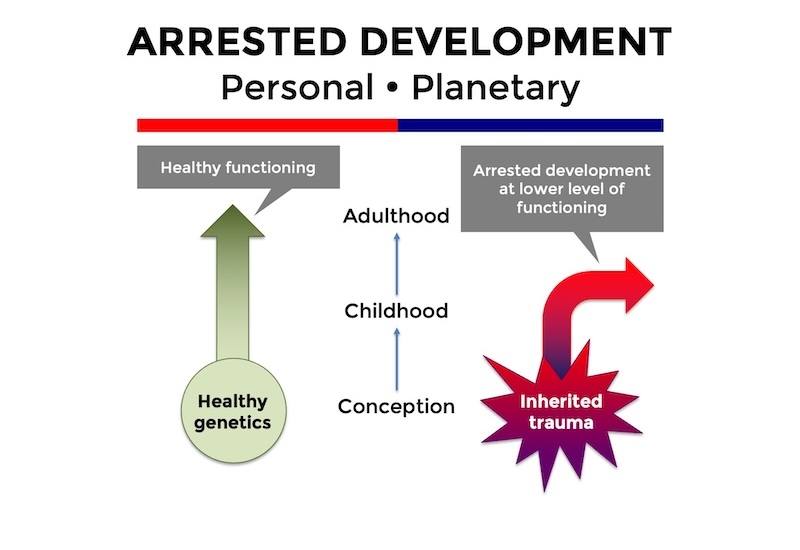
In survival-based patriarchal systems, emotional expression and sexual exploration were dangerous. Over time, entire societies shut these capacities down. The result is arrested development—the failure of key developmental tasks (psychological growth processes) to unfold correctly.
The Medical Dictionary defines ‘developmental tasks’ as:
“Fundamental achievements that must be accomplished at each stage of life, arising at or near critical stages in the maturation of an individual; successful attainment leads to a healthy self-image and success with later tasks. Failure to achieve developmental tasks at one stage leads to unhappiness in the individual, disapproval of society, and difficulty in accomplishing later developmental tasks.”
Among these tasks is the puberty task (or arc) lasting through our teens. Teens learn to shut down what remains of their natural sexuality as it presents a threat to their survival.
As adults, sexual relationships stagnate or simply lapse. Sex becomes repetitive, obligatory or disengaged. Many marriages suffer from an emotionally numb ‘hole’ at their core, where each partner hides their deepest sexual and emotional truths from a fear of rejection.
Generally, most couples are so genitally numb they’re unaware of this hole and consider themselves to have a ‘happy’ marriage, oblivious of its sexual stagnation.
This stagnation is not individual failure but a reflection of inherited constraints. When growth itself once threatened survival, the psyche learned to avoid it.
Trauma-Informed Genitality recognises that none of us received the coming-of-age practices required for healthy and lasting adult relationships.
Trauma-Informed Genitality
If the disturbance of human sexuality is rooted in trauma—particularly inherited trauma—then healing cannot come through surface-level fixes alone. It requires a trauma-informed approach which recognises the depths and origins of the wound.
Such an approach begins by understanding that:
- Sexual difficulties are protective adaptations, not pathologies
- Shame must be brought into awareness and gently released
- The body—not just the mind—must be included in healing
- Sexual issues can only be healed through engaging our sexuality
- Safety, not performance, is the foundation of healthy sexuality
This process is a journey from the genitals to the heart—a reintegration of sexuality with emotion, connection, and authenticity. Psychiatrist R. D. Laing writes: “When our personal worlds are rediscovered… we discover first a shambles… genitals dissociated from heart; heart severed from head; heads dissociated from genitals.” [10]
Trauma-Informed Genitality is the process of reintegrating these dissociated aspects. This is not about becoming more sexual in a superficial sense. It’s about becoming more whole: reclaiming a sexuality that’s grounded, relational, and aligned with our deep self.
Reclaiming life energy
Ultimately, this perspective reframes sexuality not as a problem to fix but as a vital force to reclaim. When freed from inherited shame and repression, sexual energy becomes creative, playful, and deeply connective.
What we call ‘sexual energy’ is the energy that creates and animates life—life energy. When our sexuality is dysfunctional, so is our connection to life itself.
Trauma-Informed Genitality is a process for reclaiming our connection to life.
This reclamation requires courage. It asks us to confront not only personal discomfort, but the weight of history carried within us.
The implication is profound: healing our sexuality is not just personal work—it is collective and intergenerational. By addressing these inherited wounds, we do more than transform our own lives; we interrupt patterns that have shaped and shamed humanity for millennia.
In that sense, trauma-informed sexual healing is not optional. It’s essential—to intimacy, to authenticity, and to what it means to be fully human—and fully alive.
Image courtesy of MK Gallery Life Drawing
References
[1] Reich, Wilhelm; The Function of the Orgasm (1942)
[2] DeMeo, James; Saharasia (1998)
[3] Reich, Wilhelm; The Function of the Orgasm (1942)
[4] Ibid.
[5] Ibid.
[6] Picucci, Michael; The Journey toward Complete Recovery (1998)
[7] Ibid.
[8] DeMeo, James; Saharasia (1998)
[9] Taylor, Timothy; The Prehistory of Sex (1996)
[10] Laing, R. D.; The Politics of Experience (1967)