
The sexual radicalisation of Lawrence of Arabia
- 9 March 2018
- Posted by: Michael H Hallett
- Category: History , Radicalisation , Sexuality ,
I recently wrote about the influence of unconscious shame upon the personality of perhaps the single most memorable individual to emerge from World War I, T. E. Lawrence, better known as Lawrence of Arabia.
Since then I have been reading Scott Anderson’s monumental work, Lawrence in Arabia. Anderson’s work is fascinating because, while Lawrence is its key figure, the book is actually an account of all the main intelligence operatives shaping the future of the Middle East during the dying days of the Ottoman Empire. As such Anderson brings a critical eye to the Lawrence enigma and questions some aspects of his autobiography, Seven Pillars of Wisdom.
Anderson’s meticulous examination clearly reveals the sexual radicalisation of Lawrence of Arabia.
Elliot Rodger
The term ‘radicalisation’ tends to bring to mind religious radicalisation in general and Islamic radicalisation in particular. However, as I wrote in The sexual radicalisation of Elliot Rodger, radicalisation can have other drivers, including politics, race, and—perhaps most infrequently—sex.
For those unfamiliar with Elliot Rodger, he was a young man whose unconscious shame so impaired his social skills that he was unable to find sexual partners. He eventually went on a shooting rampage at the University of California in 2014 in which seven people, including Rodger, died. On the surface, Lawrence of Arabia and Elliot Rodger have little in common. Beneath it, both were radicalised by extreme sexual shame.
On the surface, Lawrence of Arabia and Elliot Rodger have little in common. Beneath it, both were radicalised by extreme sexual shame.
Social suicide
Lawrence’s shame was born of his family situation. His father, part of the Anglo-Irish landed gentry, abandoned his marriage to live with a commoner under the assumed name of Lawrence. In prurient Edwardian England this was the social equivalent of suicide, denying a privileged future to not only the daughters left behind but to their five sons, of which Thomas Edward (‘Ned’) was the eldest.
Ned’s mother was a staunch believer in physical punishment and it appears to have been her eldest son who bore the brunt of this. This would have inflamed Ned’s core mother wound. In tandem with the socially illicit nature of his parents’ relationship, which Ned discovered at a young age, this created a violent rejection of both the body and sexuality in his psyche. (See Lawrence of Arabia – a shame-driven hero?)
King Arthur
Reacting to this, Lawrence developed a fascination with the Arthurian legends. This led him to become an expert on the fortresses of the Crusades, reading history at Oxford and, eventually, to archaeological digs in the Middle East.
This was no random interest. In early 20th century Arabia, Lawrence found a world of noble, sword-waving warriors battling inhospitable conditions for idealistic notions of honour and glory. In this living Camelot, sex was something that happened in the margins—or didn’t happen at all. Forced to travel for days on end through pitiless desert just to access basic amenities, Bedouins had little opportunity for intimacy.
And if there was one thing T. E. Lawrence hated, it was intimacy. He abhorred physical touch and avoided shaking hands whenever possible. By the time he joined British intelligence in Egypt in 1914, Lawrence was well on his way to radicalisation.
The process of radicalisation
The psychological process model I use for radicalisation has eight steps. It’s a generalised model but has proven useful in charting the descent into violence of radicalised individuals including Elliot Rodger, Columbine School shooters Eric Harris and Dylan Klebold, and now Lawrence:
- Discrimination—real or perceived
- Frustration—with existing avenues of expression
- Victimisation—sense of institutionalised injustice
- Humiliation—incident-driven ‘cognitive opening’
- Rejection—breakdown of community cohesion
- Alienation—vulnerability to extremist narrative
- Indoctrination—acceptance of extremist narrative
- Perpetration—execution of extremist narrative
Growing up in a socially outcast family, Lawrence passed through the first three stages during his upbringing. The fourth stage, humiliation, is crucial. This is the stage that propels disaffected individuals to extreme violence. The war was to supply Lawrence with this experience.
There are two questions about the Lawrence myth that remain unresolved: Was his relationship with Dahoum, a young Arab man he met on a pre-war dig, of a homosexual nature? And what actually happened when the Turks captured him at Deraa? When the evidence is filtered through the understanding that Lawrence was radicalised, likely answers to both questions emerge.
Deraa
Prior to Deraa, Lawrence’s was a dreamer’s war. He was fighting for the ideal of a sovereign Arab nation where his latter-day Arthurian fantasies could play out. That changed in November 1917 when Lawrence, dressed as an Arab, ventured into the Turkish-held railhead at Deraa to gather information. With his light skin he was suspected of being a Turkish deserter and arrested.
According to Scott Anderson, Lawrence gave three distinctly different accounts. In a letter to a friend in 1919, Lawrence claimed that the Turks knew who he was but he escaped after being left unguarded. Given the bounty of 20,000 Turkish pounds on his head, this seems improbable.
In Seven Pillars, Lawrence wrote that the Turkish governor, or Bey, tried to rape him but he resisted, for which he was severely whipped and beaten. Anderson is also suspicious of this account, given that within days of Lawrence’s escape from Deraa two things happened: he set out on an arduous cross-desert trek, hardly consistent with being tortured. He also went through a noticeable personality change, becoming more alienated—stage six above—and violent.
“Bodily integrity”
That leaves the third account. It was written in 1924 in a letter to Charlotte Shaw, wife of writer George Bernard Shaw, and the only woman with whom Lawrence seems to have had any kind of connection. In it, Lawrence confesses that he surrendered his “bodily integrity” to the Bey. What could this be, other than an admission of rape?
There are clues in Seven Pillars that support this. Lawrence devoted five pages to his mistreatment by the Turks. But, as Anderson notes, “there is something in the sheer accumulation of such ghastly detail that serves to cloud the narrative, to make vague what really happened.”
While the physical clues may be vague, the emotional ones are not. Lawrence wrote that while being kicked in the ribs “a delicious warmth, probably sexual, was swelling through me”. It’s hard to see what the word ‘probably’ is doing in that sentence, other than laying a smokescreen. After his ordeal he “snuggled down, dazed, panting for breath, but vaguely comfortable.”
Taken in toto, it’s hard to escape the sense of a repressed homosexual forced into an act he was too ashamed to initiate. We will never know for certain, but in his overwritten Seven Pillars account Lawrence may have been trying to admit the inadmissible. Not only did his socially shameful feelings find a mirror, but—worst of all—it brought a certain relief.
Humiliation
But shame is a multifaceted beast. Whatever the truth of Deraa, there is no question that the judgmental aspect of Lawrence’s psyche reacted strongly to his treatment by the Bey. Anderson describes its impact on Lawrence in a single word: humiliation.
This is the pivotal fourth stage in the radicalisation process. Past this stage, there is rarely a way back. Ten months later, Lawrence returned to Deraa. There, to quote Anderson, he would “commit some of his most brutal acts of war, acts that would carry the very strong scent of vengeance.”
Whatever the truth of Deraa, Anderson describes its impact on Lawrence in a single word: humiliation. This is the pivotal fourth stage in the radicalisation process. Past this stage, there is rarely a way back.
Desert warfare, with its crucial dependence on scant water sources, makes prisoners a luxury at the best of times. Yet, prior to Deraa, it was a luxury that Lawrence sometimes indulged in, such as the ambush at Fuweila that paved the way for the audacious capture of the strategic port of Aqaba. After Deraa, his battle cry changed.
“No prisoners”
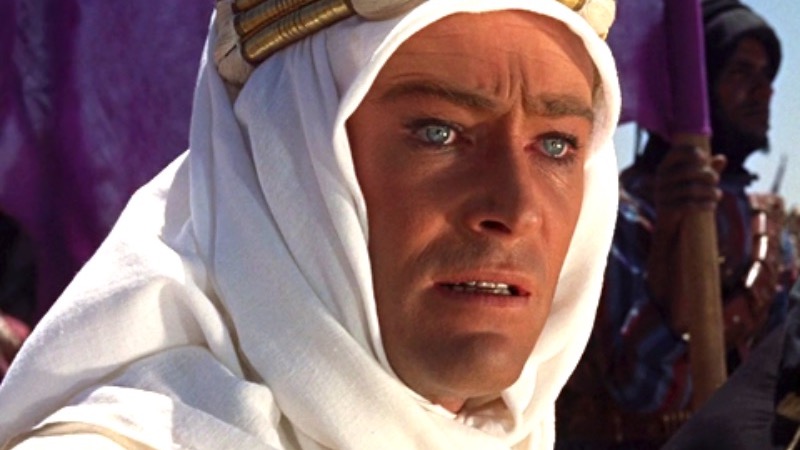
After Deraa, Lawrence was merciless as he tumbled through the final stages of the process of radicalisation. His war had become personal. This is brilliantly portrayed by Peter O’Toole (above) in the notorious “No prisoners!” sequence in David Lean’s epic film Lawrence of Arabia.
Lawrence’s radicalisation, founded on extreme sexual shame, also provides a likely answer as to whether this relationship with Dahoum was sexual. Personally, I doubt it. Dahoum represented Lawrence’s ideal, an ideal of which asexuality was a significant component. Lawrence would have been too ashamed of any sexual feelings for Dahoum to ever express them. Only in the dungeon of the Bey of Deraa did Lawrence find a situation where homosexual expression could take place in a way his sanctimonious society could not condemn.
‘Arthurian Arabia’
None of this is said to disparage Lawrence. He was clearly an extraordinary individual. His support of Arab independence—to the extent of revealing to them the secret Sykes-Picot Agreement, a treasonable offence—was years ahead of his time, even if impelled by his sex-negating fantasy of an ‘Arthurian Arabia’.
Countless words have been written about T. E. Lawrence. Few of them, to my knowledge, have recognised the overarching impact of shame on his shooting star trajectory. Nor have they identified Lawrence as what we would now call a radicalised individual. The sharp contours of his brilliant life provide us with key insights into these otherwise nebulous emotional conditions. Even in death, T. E. Lawrence retains a compelling ability to fascinate and educate.
Image: Peter O’Toole in Lawrence of Arabia (1962 / public domain)

Lawrence was asexual like Charlotte Shaw. They both hated the idea of sex and Charlotte Shaw had a very dominant mother who she hated. She did not consumate her marriage to George Bernard Shaw. Lawrence had a very dominant mother too.
However, Lawrence tried to live in the spirit not the body. It is Fareedeh al Akle that says this to the biographer Benson-Gyles who wrote the book The Boy in the Mask. Lawrence was brought up in a strictly evangelical christian family and he says he was frightened of animal spirits or the animal. Although he did not folliw organised religion he tells Clare Sydney Smith thst he still believes in Jesus and that he lives out a very ascetic lifestyle. He says he is a one man secular monastery if there could be such a thing. It makes far more sense to see Lawrence as celibate particularly in the light that in conversations with a friend at University he decides that Christ is the greatest man to tread the globe and that he will emulate him. He is also complimented by a friend who says his Christ like behaviour was supreme.
Lawrence was not a deviant but possibly asexual or celibate person who does not want sex or does not like sex but thrives on close relationships. However, he was also desperately shy and says to his brother that his diffidence is his gaoler and he cannot even consider the possibility of marriage. He also said he would look longingly at a man cuddling a woman or stroking a dog and wanted to be that shallow but could not be. Winston Churchill said he was a savant and many close to him say he was a genius. I have heard it said that he was on the spectrum or neurodivergent which fits in with those comments and not wanting to be touched.
John Mack said he was a masochist. I challenge this because Lawrence says he was frightened of pain and when he was raped and beaten in Deraa he said it was not the defilement of the body that was so devastating because he had never held the body in much esteem but it was the pain thst broke through his strong will his citadel that protected his inner self. He describes the pain as a flaming wire that was so unbearable he gave away the one thing of great value to man the integrity of his body and thst this was an unforgiveable thing. If there was any truth in John Bruce’s well paid article to the Times that Lawrence paid him to be beaten (and John Bruce had been found lying before), Lawrence did not request John Bruce to beat him for pleasure as a masochist might do, but to challenge that fear of pain that had made him give in to any sexual pleasure that the turks requested.
Hi Liz, many thanks for this, very interesting.
All that you have written tallies with my view that Lawrence was shaped by profound shame, both inherited through generational trauma and reinforced through his upbringing.
My view is that both asexuality and the dislike of being touched are unconscious responses to shame; the shame came first and the behavioural traits followed.
Michael
This is your perspective. Other articles suggest that he had sadomasochistic tendencies and even Lawrence himself wrote about pain and being whipped in a way as if it gave him pleasure. So who is right here? Difficult to tell.. Apparently he had a strict mother who frequently beat him. Lots of masochists are “born” like that believe it or not..
Thanks. Yes, it’s very possible there was a pattern of masochistic behaviour in the family. Nature and nurture are not opposites, they tend to reinforce each other. Deep shame is clearly present in the family. Pain and punishment feels welcome (i.e., experienced as pleasure) as it resonates with the shame.
Absolute nonsense! The shame came from being illigitimate which was a real stigma in those days. Lawrence was a strong evangelical Christian. His shame was nothing to do with his Christianity and everything to do with being raped and beaten in Deraa plus in those days when he was a child, parents used to apply the rod. You need to separate out his shame and Christianity. They are not the same things. And I do not believe in the masochism claims by Mack in his book The Prince of our Disorder. It is based on that liar, John Bruce who needed money and sold his story to the Times newspaper. Even one of the reporters on The Times said John Bruce was lying and the man needed money in his old age. Arthur Russell Lawrence’s great friend from the forces said John Bruce was never around. It’s like the lies around whether he was beaten or not. Arthur Russel went swimming with him at a beach near Lulworth Vive when they were in the Tanjs Corp. He saw and attested to the scars on his back. Clare Smith his CO’s wife in the RAF said she saw him when he was swimmjng inntheur swimming pool and he was covered in scars. Lawrence’s brother, Arnold, said about the Arab Revolt that it ruined him. Fareedah al Akle, a Syrian Christian and the lady thst taught him Arabic before the war could see the difference in the man she met in London after the war. His smile had gone and he was ashamed about his illigitimacy. It’s utter nonsense to suggest his shame was his Christianity and it’s offensive. I know about this level of persecution. Atheists do it to me. I am celibate and Holy Spirit baptised, similar to 1 Kings 8-11. I suspect you know nothing about his Christianity. He was complimented by one of his sergeants in the RAF as being better than Christ. One of his publishers said that his emulation of Christ was superb. He decided at university that the best man who ever trod the globe was Christ and he would emulate him. Fareedah al Akle said, he lived in the Spirit not the flesh and that it was his wonderful character and personality that made him great not his exploits in the desert, great though they were. His monastic lifestyle would be why he had such endurance in the desert. The denial of possessions and comforts is the perfect training ground for endurance. I suppose all the special forces veterans who followed Lawrence’s 600 mile route across the desert to Akba by camel in 2024 to raise money for charity are madochistic too!!
His commanding officer’s wife in the RAF who became a great friend, Clare Smith, said he still believed in Jesus and lived a monastic lifestyle in the secular world. It’s in her book The Golden Reign. He didn’t like organised religion, particularly the Church of England. He fell out with the Bishop of Jerusalem over one of the Zionist leaders, who he said they were not good enough to black his boots.
It’s so important to understand how much if this is the essence of the man. From a very young age he saw himself as a chivalric knight, a member of King Arthur’s roundtable, which was based on Christian values. His favourite book was The Death of Arthur, which is all about the Holy Grail or/and presence of God.
Absolute nonsense! The shame came from being illigitimate which was a real stigma in those days. Lawrence was a strong evangelical Christian. His shame was nothing to do with his Christianity and everything to do with being raped and beaten in Deraa plus in those days when he was a child, parents used to apply the rod. You need to separate out his shame and Christianity. They are not the same things. And I do not believe in the masochism claims by Mack in his book The Prince of our Disorder. It is based on that liar, John Bruce who needed money and sold his story to the Times newspaper. Even one of the reporters on The Times said John Bruce was lying and the man needed money in his old age. Arthur Russell Lawrence’s great friend from the forces said John Bruce was never around. It’s like the lies around whether he was beaten or not. Arthur Russel went swimming with him at a beach near Lulworth Vive when they were in the Tanks Corp. He saw and attested to the scars on his back. Clare Smith his CO’s wife in the RAF said she saw him when he was swimming in their swimming pool and he was covered in scars. Lawrence’s brother, Arnold, said about the Arab Revolt that it ruined him. Fareedah al Akle, a Syrian Christian and the lady thst taught him Arabic before the war could see the difference in the man she met in London after the war. His smile had gone and he was ashamed about his illigitimacy. It’s utter nonsense to suggest his shame was his Christianity and it’s offensive. I know about this level of persecution. Atheists do it to me. I am celibate but not asexual and lije sex but decuded to abstain oarticularlyvas sex in the modern era us do perverse with the Jeffery Epsteins of this world and I am Holy Spirit baptised, similar to 1 Kings 8-11. I suspect you know nothing about his Christianity. He was complimented by one of his sergeants in the RAF as being better than Christ. One of his publishers said that his emulation of Christ was superb. He decided at university that the best man who ever trod the globe was Christ and he would emulate him. His monastic lifestyle would be why he had such endurance in the desert. The denial of possessions and comforts is the perfect training ground for endurance. I suppose all the special forces veterans who followed Lawrence’s 600 mile route across the desert to Akba by camel in 2024 to raise money for charity are masochistic too!!
His commanding officer’s wife in the RAF who became a great friend, Clare Smith, said he still believed in Jesus and lived a monastic lifestyle in the secular world. It’s in her book The Golden Reign. He didn’t like organised religion, particularly the Church of England. He fell out with the Bishop of Jerusalem over one of the Zionist leaders, who he said they were not good enough to black his boots.
It’s so important to understand how much if this is the essence of the man. From a very young age he saw himself as a chivalric knight, a member of King Arthur’s roundtable, which was based on Christian values. His favourite book was The Death of Arthur, which is all about the Holy Grail or/and presence of God.
And something else following on from my last comment. This masochism or sado- masochism. It has sexual connotations. Therapists broaden it out now and say it’s not always sexual but it has connotations. John Bruce, the man, who penned the story of being paid to beat Lawrence said himself it was not sexual. Arnold Lawrence said it was for punishment like the medieval saints. I think I know what Lawrence would have been doing if the story is true. He was very shocked by the pain of being beaten and described it as like a flaming wire wrapping around him. It is why he had to give in to the homosexuality because he could not stand the pain. He said this was unforgiveable. Like many special forces men, he had challenged his body and had overcome and overcome with his very strong will (something he mentions regularly – his Will). I think he was shocked he could not endure the pain and probably if John Bruce’s story is true, he was trying to control it through the beatings he paid John Bruce for.
In my mind overcoming matter or the flesh by living in the Spirit is like Christian Science, the religion of his old friend, Lady Astor. They must have had very many discussions.
And to clarify the badly spelt comment in my previous message:
I am celibate but not asexual and like sex but decided to abstain particularly as sex in the modern era is (sometimes) so perverse with the Jeffery Epsteins of this world.
“Only in the dungeon of the Bey of Deraa did Lawrence find a situation where homosexual expression could take place in a way his sanctimonious society could not condemn”.
Firstly sexual abuse and rape has the component of the poor victim sometimes enjoying it which is shaming for the victim afterwards and why they often blame themselves. That is the nature of sex when the body takes over and why grooming works in child abuse. I do not believe that Lawrence’s rape was a situation where homosexual expression could take place. It tells you nothing except that sexually there is a point of no return and the body takes over. He’s already been beaten into submission before he is raped. Beaten until he bled and he bore the scars to prove it. Whether he felt some sexual arousal is neither here ir there.
The so-called claims of homosexuality with Dahoum is because he gets him to pose naked to sculpt him. In this modern over sexed age it becomes homosexual but his brother Arnold posed naked for Scott of Antartic’s widow who sculpted him naked and created a beautiful stature that has been erected at the institute in Cambridge. She was not accused of sexual feelings for Arnie. There is also a pencil drawing that I have of Lawrence naked by one of his artists. These incidents are more art than sex. It is nonsense to assume they are sexual. There is no proof.
Also you tar Lawrence as does Scott Anderson with a modern day brush. Lawrence like many of his day did not understand sex in the way we do today. He had no idea women had orgasms. He said he could not imagine why a woman would want that done to her and there was a Professor of Medicine at the time who said women don’t like sex and if they do they are whores. Sex was not understood then like it today, that came after the Kinsey report.
I hate all this Freudian clap trap. God protect us from it. Freud was a cocaine addict that had to be admitted into his own asylum to come iff it, which really was a case of the inmate running the asylum. It would be more interesting if there were a survey of those cases that went through similar personal circumstances but did not turn out to commit violent acts. You mention the massacre but you fail to say that what Lawrence saw first was a terrible massacre committed by the turks with a dead pregnant woman who had a sword thrust and stuck between her legs or the butchered babies and children or the child with the gaping wound who died in front of them. Or Talas who charged the Turks in a suicidal show of feeling as chief of his tribe. More likely it was the aroused tribal feelings that created the revenge massacre that Lawrence was involved in.
And why section Lawrence out? I saw a photo in National Geographic of a tribal man with a spear in one hand and his erection in the other. Probably the first and only pornographic picture found in a National Geigraphic magazine.
War has terrible affect on soldiers. Explain the rape pillage and murder that advancing troops often commit.
You say you are not denigrating Lawrence. He was an extraordinary man but really you are denigrating him.