Trauma-Informed Genealogy: where history and healing meet
- 29 April 2026
- Posted by: Michael H Hallett
- Category: Genealogy , Generational trauma ,
There is a quiet convergence happening that is, as yet, largely unrecognised.
On one side are therapists, working with the symptoms of trauma as they appear in the present: anxiety, depression, addiction; stumped by dysfunctional family constellations. On the other side genealogists: uncovering records, reconstructing family trees, unprepared for the emotional impact of uncomfortable finds.
Between them lies a shared midpoint: Trauma-Informed Genealogy.
What is Trauma-Informed Genealogy?
Bernadette Thompson from the Ancestral Healing Center describes it as follows:
Trauma-Informed Genealogy is a facilitated method of researching family history — not simply to collect names and dates, but to uncover the hidden patterns, silences, and emotional legacies that shape how we live today. A trauma-informed genealogist guides the participant through a process that begins where traditional genealogy begins — with fact-finding — but reads the record differently. We are looking for what is absent as much as what is present. We are looking for disturbances beneath the surface.
Trauma-Informed Genealogy is where family history and personal healing meet. To do this we must recognise that the family tree is the map therapists lack, while an understanding of—and feeling for—trauma are the tools genealogists are missing.
At present this nexus is a kind of Bermuda Triangle where both disciplines’ competencies and boundaries blur, to their—and our collective—loss. To resolve this, we must bring the nature of trauma itself into focus.
Trauma as a system
Trauma is not a single event—it’s a system. The Hindi word ghatnā, meaning ‘event’ or ‘incident’ hints at this: an event, even an everyday incident, may be part of a broader, ongoing tragedy that courses largely unrecognised beneath the surface of life.
As I write in Trauma exists as a series of ripples, trauma behaves less like stand-alone events and more like ripples that disrupt our wellbeing. Each ripple interacts with others—current-life experiences, unresolved family traumas, community histories—creating a multi-layered, interdependent emotional soup where past and present are ultimately inseparable.
What surfaces in therapy is rarely self-contained. A client’s panic may not be entirely theirs. Their behaviours may be repetitions from ancestors in other lifetimes; their responses merely echoes. The genealogist uncovers the facts but does not see—or, more importantly, register—their emotional significance.
To work only at the individual or factual level skims the surface while ignoring the depths.
The trauma map
Traditional genealogy is chiefly concerned with facts: people, places, dates. These facts are dissociated from the feelings our ancestors experienced as they navigated their lives. Viewed through a trauma-informed lens, those same records become a diagnostic tool.
The trauma-informed genealogist doesn’t just assemble a tree. They’re tracing the fault lines of emotional inheritance. The cracked ice of our family’s past—still spreading under our feet—is exactly the map we need to understand addictions and disturbed dynamics.
Look again at the record:
- Disconnection or disappearance of family members
- ‘Long lost’ family branches no one speaks about
- Repeated patterns of early deaths, addictions, or adultery
These are not anomalies. They are distress signals. Families don’t become fragmented by accident. They shatter under the weight of shame—affairs, failures, abuse, abandonment—and those fractures persist and replicate across generations.
The genealogical record doesn’t just preserve history; it preserves the skeleton of trauma. This is not a fossilized record: it’s still alive in the present generation. A family’s traumatic past creates a critical events map—for both disciplines.
What therapists are missing
Many therapeutic models are constrained by a present-life framework.
Even when therapists are trained in family systems, they lack the genealogical skills to unearth the underlying emotional truths. Questions about parents or grandparents merely reveal the client’s ignorance of their own family history—factual, let alone emotional.
In my Family Stability Index exercise, I ask clients how many of their birth grandparents were alive and ‘in good standing’ in their family when they were born. The range is from 4 to 0. I’m a 0—a clear red flag of past family breakdown that must leave its mark on the present.
If a client has a persistent sense of abandonment, as I did during childhood, the question is not what happened to you? but what happened in your lineage that is still happening through you? Without genealogy, therapists are often blind to the origins of deep patterns.
What genealogists are missing
Conversely, genealogists often work without an awareness of trauma dynamics. They collect data but overlook meaning. They document events but miss the emotional charges embedded in them.
A trauma-informed approach focuses the lens:
- Divorce is not just a legal event—it may signal unresolved abandonment
- Migration is not just movement—it may represent exile, loss, or survival
- Silence in the record may be more significant than it seems
In addition to seeking the emotional dimension of events, the trauma-informed genealogist must learn to look for what is not there—the skeletons in closets, the bones in the fields, the disturbances in the narrative and the unexplained silences. All these, which may have left no record whatsoever, may contain greater insights into family stressors and dynamics than the most meticulously documented family tree.
In this sense, Trauma-Informed Genealogy is less about filling gaps and more about interpreting them.
A shared language
At this midpoint between therapy and genealogy, something powerful emerges: a shared language. Genealogy provides the context. Therapy provides the process.
Together, they allow us to do something neither can do alone: trace the origin of dysfunction and consciously interrupt its transmission.
This is not abstract. It’s deeply practical. When a therapist recognises that a client’s pattern of emotional withdrawal mirrors three generations of paternal abandonment, their approach changes. When a genealogist recognises that a broken branch of ‘long lost’ relatives reflects shame, expulsion, disinheritance and social distancing, the family narrative changes.
In both cases, the past becomes actionable—with deep sensitivity.
Living with ghosts
Trauma-Informed Genealogy is an act of critical listening. Not just to stories, but to their echoes—and their absences. Not just to what is remembered, but to what has become fragmented and to what’s been consciously or unconsciously forgotten.
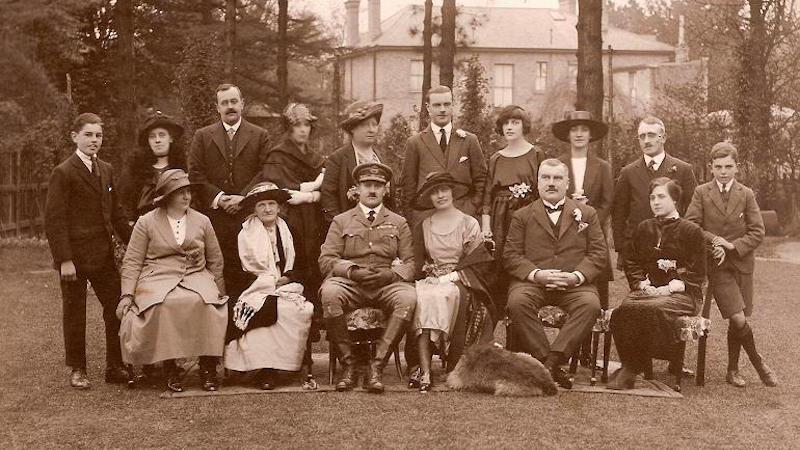
The photograph above is an example. It’s my maternal grandparents’ wedding in 1921. A little over a decade later, the marriage collapsed in acrimony after my grandmother had an affair. Later in life, my mother wrote on its back: “this would be father with his bride. This would be 1913.”
It would not be 1913. My grandfather wears the uniform of a Wing Commander in the Royal Air Force, an organisation that did not exist until 1918. My mother was unable to recognise her own mother in the photograph. Time, distance, forgetfulness and dissociation all played their part in lapsing my grandparents’ tragedy into silence while its emotional repercussions rumbled on over three generations.
As I write in Living with ghosts – confronting generational trauma, our ancestors and their unresolved stories live on in patterns of beliefs and behaviours that make no sense—until we examine their lives with compassion. Trauma-Informed Genealogy is the language through which they may speak for themselves, rather than through our disturbances.
And when we learn that language, when we follow the trail into the murky past, we’re not merely uncovering history. We’re participating in its—and our own—healing.
An emerging discipline
Trauma-Informed Genealogy is not yet a formal field. But it’s already taking shape, the natural nexus of two growing fields of study that have until now not seen in each other the missing pieces of their current toolkits.
It asks more of both disciplines:
- That therapists expand their scope beyond the individual into lineage
- That genealogists expand their scope beyond data into meaning
Most importantly, it asks us to reconsider what a family tree actually is. Not a static record of who begat whom, who divorced, who survived. It’s a living system of inherited experience—of ruptures and adaptations, of wounds and survival strategies—and ultimately of triumph.
A map, not just of ancestry, but of the unconscious patterns that shape our lives. And, if we learn to read it properly, a map that shows us not only where we come from—but how to stop carrying forward what was never ours to begin with.
Photo: Hallett family