
Arrested development – humanity’s collective immaturity

As I write this, the 2026 World Economic Forum annual meeting is taking place in Davos, Switzerland. Eyes are focused on our increasingly fractured and unstable world. Giants of the global stage such as Donald Trump and Elon Musk behave in increasingly irrational ways: trigger, argument, polarisation, fallout. In a word, infantilism.
Events at the global level are macro versions of what’s happening at the micro level of communities, families, and individuals. As above, so below. From the corridors of political power to those of the family home, the hallmark of our time is not maturity, but unresolved childhood issues projected into adulthood: ‘throwing our toys out of the pram.’
If we step back from surface events—world affairs, celebrity feuds, family niggles—a deeper pattern emerges. What we see isn’t isolated dysfunction, magnified by social media reach, but collective arrested development: a civilisation that, despite its technological sophistication, remains psychologically immature, irresponsibly short-sighted, increasingly reactive.
What is arrested development?
In psychology, arrested development refers to a failure to fully mature emotionally and cognitively. In her best-selling memoir of family trauma, The Architect of Desire, Suzannah Lessard writes flatly: “I had failed to develop an adult context for myself.”
As human beings, we have three key psychological ‘development arcs,’ or circuits, leading from infancy to maturity:
- Mother-child arc from conception to about age 6½: connection, communication, community. It paves the way for healthy nurturing, self-worth and belonging.
- Father-child arc from about ages 6½ to 13: boundaries, negotiating with others, healthy work. It paves the way for the responsible use of power.
- Puberty arc from about ages 13 to 19½: integrating the first and second circuits to become a responsible, productive, community-centric, sexually active adult.
I use the quite precise span of 6½ years for each circuit. It’s no coincidence that from thirteen to nineteen is a specific life stage. It’s important to note that each circuit can only develop healthily to the extent that its predecessor(s) developed healthily.
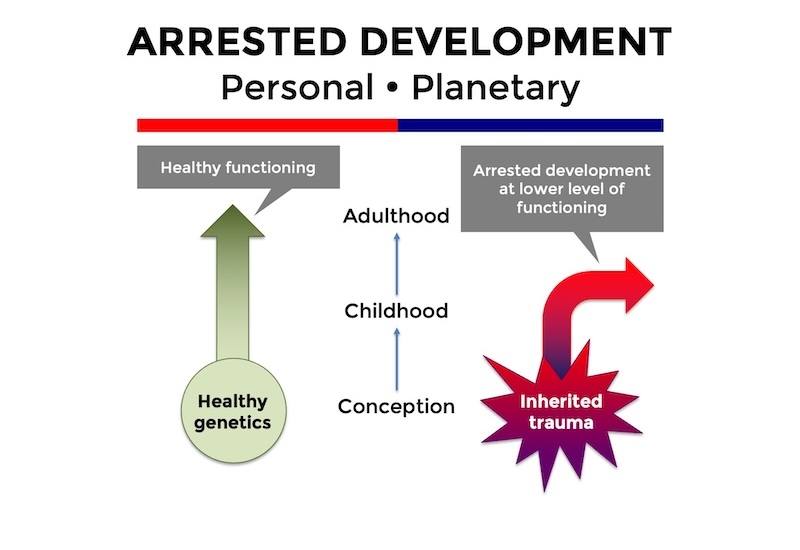
Genetically healthy parents nurture in healthy ways, reinforcing a spiral of positive psychic development. To the extent that trauma exists in a family, its nurturing is compromised. The spiral stalls and ultimately becomes negative, increasing in impact across generations.
Much of our behaviour is shaped not by integrated growth but by remnants of survival strategies from our past: responses forged in trauma, propagated through generations as unconscious patterns, now masquerading as ‘normal’ adult behaviour.
The individual immaturity of 8 billion human beings aggregates into collective immaturity. That a seemingly intelligent nation can vote an overgrown child into its highest office—twice—shows how normalised this immaturity is.
The Patriarchal Operating System
At the root of this arrested development is what I term the Patriarchal Operating System—an immature psychological default that emerged from ancient trauma and has become embedded in our genetic (internal) and social (external) architectures.
In Saharasia, geographer James DeMeo shows how climate change from around 4000 BC turned the Sahara, Middle East, Arabia and Central Asia into deserts. It also radically altered the human psyche. Prolonged famine turned peaceful hunter-gatherer cultures into nomadic warriors. Everything associated with the feminine became shameful. Evidence of this can be found in geographical and historical records, in climatology, anthropology, and psychology.
As genuine nurturing failed, arrested development became humanity’s new normal.
The Patriarchal Operating System conditions us to suppress the feminine aspects of our being: emotional intelligence, relational sensitivity, self-reflection, responsibility for our inner experiences. These suppressed parts don’t disappear. They surface as fragmentation, emotional fragility, reactivity, and desperate entitlement.
Political leadership
Across cultures and systems, leaders behave like adolescents with power tools.
They posture, react defensively, and seek validation through domination. They fail to take responsibility—not only for their own feelings, but for the consequences their decisions have on others and the planet.
Politics has become a stage for unresolved inner conflict, unconscious wounds playing out in public. The very systems designed to steward societies end up amplifying survival behaviour: insecurity, projection, a desperate need for external validation.
The spat between Musk and Ryanair CEO Michael O’Leary resembles two 7-year-olds having a pillow fight over who gets the top bunk—except that they, and others, fight with enormous political, economic and military resources, heedlessly putting capital and lives at risk for transient gloating and settling petty emotional scores.
These are not mature adults making rational decisions. They are children with great external authority, lacking the inner structure to use it wisely. They look like slightly pathetic robots unable to condition their responses to the demands of a situation.
Family dynamics
Within families, the same pattern persists.
Parents who never learned to integrate emotional experience reproduce the very wounds they inherited. Abandonmentbegets abandonment, either physical or emotional. Musk and former British Prime Minister Boris Johnson have both left a trail of children by previous partners in their wake.
When nurturing fails, the family line remains truncated, its wounds carried forward like a shadow into future generations. Without inner work (‘shadow work’), this is the soil out of which immature (re)actions—both small and catastrophic—continue to sprout.
This collective immaturity manifests in countless micro-dynamics: a parent unable to regulate rage, a sibling trapped in resentment, a friend who can’t hold vulnerability, a neighbour who terrorises their street, a stalker on social media.
Each is a symptom of arrested development on the personal level. Each is part of the same pattern playing out in geopolitics, economics and other global systems.
Collective immaturity is fixable – one by one
The only exit from this frozen state is to bring to light what is unconscious: the shame, the defensive survival strategies, the failed nurturing, the absent boundaries and other inherited emotional legacies that drive reaction over reason.
When we begin to see these patterns in ourselves, we stop reenacting them unconsciously in the social sphere. We begin to take responsibility—that deeply painful act of acknowledging our inner woundedness, rather than projecting it onto others.
When families become conscious of the invisible emotional scripts they carry, generational trauma begins to unwind. Collective immaturity is fixable—but only at the individual level. There is no point blaming Trump, Musk, ICE, Putin or anyone else for the state of the world. They’ve all been put in place by the projected hurt of the collective unconscious.
Political maturity, like personal maturity, begins with self-awareness. When leaders and citizens alike become willing to explore their own inner failings, to recognise how fear and shame drive policy and discourse, we create the pre-conditions for responsible leadership.
Arrested development isn’t just a label. It’s a diagnosis of our collective psyche. And like any diagnosis, it points to a need for healing: awareness, responsibility, and integration.
Until we do this, humanity will continue to behave like a child given power without the wisdom to use it—masculinity without maturity, authority without accountability, and consciousness without its mirrored reflection.
Photo by Phillip Glickman on Unsplash