101 Years after a double tragedy, closure
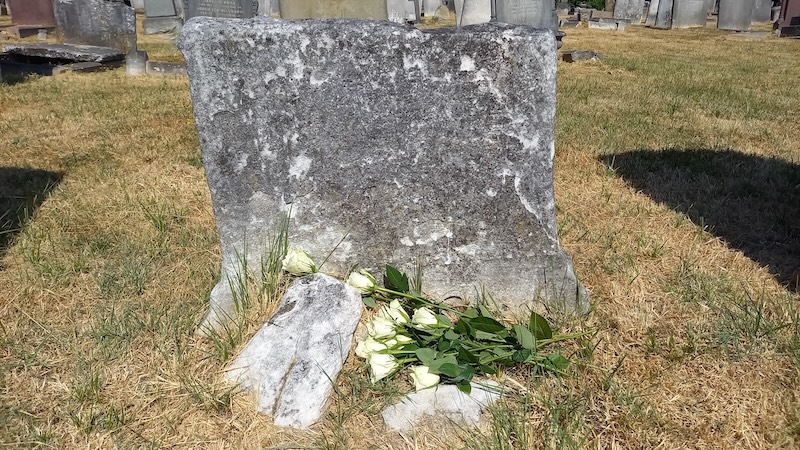
Image: Michael H Hallett
In an excellent Substack article titled Why You Should Really Kill Off Your Ancestors, Paul Chiddicks writes: “For those of us who like our family trees to be tidy and complete, a death certificate closes the final chapter of an ancestor’s story.” Yet there can be an epilogue beyond a £3 PDF of a century-old certificate. Standing before a slab of stone with your ancestor’s name may bring further closure.
Closure
Yesterday, I travelled to Wandsworth Cemetery in south London to visit the grave of my great-uncle Eric Alfred Gordon Lister. Having to travel 25 stops on the Northern Line—from Edgware to Clapham South—in 37-degree heat made it quite an ordeal. Yet the sense of closure was worthwhile.
As I describe in The day my mother’s family died, Eric (aged 26) contracted pneumonia on 10 April 1925. His father, Arthur George Lister (54), was already bowed from a life of hard blows: the loss of his eldest son at age eight, the demise of his marriage, six months in prison for tax fraud—during which his health seems to have badly deteriorated.
Eric’s illness was the last blow. Arthur died of cardiac failure in Hackney on 12 April, followed by Eric the following day—at the Beaumont Hotel in Bayswater, according to family lore.
They were interred on the same day, 16 April 1925, Eric in Wandsworth Cemetery and Arthur in Manor Park Cemetery in Hackney Wick. How Arthur was buried in a private cemetery after his financial fall from grace is a mystery.
The burial card
Equally mysterious is how Eric’s burial card survived—a small card, 4½ x 3”, bearing name, burial date, and grave number. A time, 2.30pm, is noted in a corner. (Although the card is correct, Eric’s surname is misspelled ‘Lester’ on the cemetery database.)
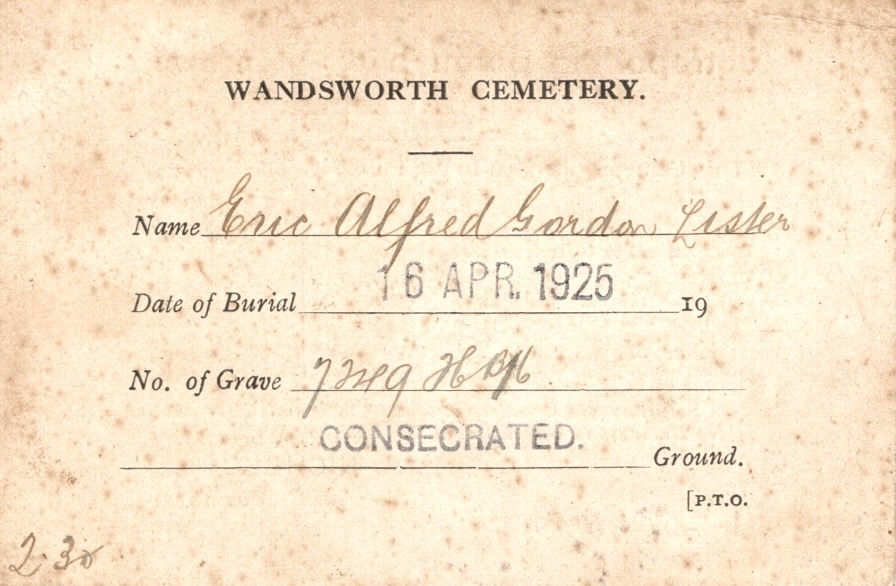
Clearly, the card was given to my grandmother, Violet Louise Lister, as Eric’s eldest surviving sibling—with Eric’s father dead and his mother Charlotte Brockhurst having left at least a decade earlier.
The mystery lies in how the card passed from Violet to my mother, given that Violet had an affair in the 1930s and was expelled from the family. My guess is that it was found in Violet’s effects after she died in Cornwall in 1966.
Her second husband, industrialist Oswald Short, contacted my parents. I remember visiting Rock, Cornwall, when I was five—possibly my oldest memory. Various items were passed on to my mother, which must’ve been bittersweet after three and a half decades of separation.
Assumptions
Based on this card, my mother drew up a family tree, probably in the late 1990s, with Eric A. G. Lister named as her grandfather. (Her grandmother’s name was blank.)
When I first started digging into this generation, before I discovered the 1925 double tragedy, I assumed that after Arthur’s death Eric may have stepped in as a de facto grandfather in my mother’s life.
My visit to Wandsworth highlighted the fragility of such assumptions. There was a prior assumption in play—by my mother—distorting the family narrative.
As this card survived—but no narrative to explain it did—she must have assumed that Eric was her grandfather. There was no equivalent card for Arthur G. Lister to document the truth. This absence exposes a fault line.
Double burial
Arthur and Eric were interred on the same day, but 17 miles apart. It’s possible the family attended both burials—yet in that case why did Arthur’s burial card not survive along with Eric’s? We know that Violet was most likely at Wandsworth Cemetery on 16 April 1925 at 2.30pm. But was she at Hackney Wick in the morning?
Sometimes, it’s the absences in the genealogical record that tell the truth.
Did the family distance itself from the troubled figure of Arthur, his name tainted by the £46,000 tax fraud (£2.3m today) that sent him to prison? Two months later, his eldest living son emigrated to New Zealand; his last son went in 1929. We followed half a century later.
Yet this is false closure, ignoring the physical reality of the past in the hope that it’s psychological shadow will vanish. Thanks to online databases such as FreeBMD—and the legions of volunteers who populate them—we can now reconstruct at least some of the past with a reasonable degree of accuracy.
White roses
That trail led me to Wandsworth Cemetery yesterday where I encountered a broken slab of stone, seemingly weathered well beyond its 101 years. Little could be made of whatever dedications it once bore.
There were, however, little drilled points where it appears letters and numbers may have once been attached but since lost. Knowing Eric’s full name, I was able to see its outline on the stone. He has lain there for a century, possibly untroubled since the day he was interred, his name a cipher without a story on the fringes of my family’s fragmented narrative.
I laid white roses on his grave to mark his brief journey and premature exit, and to honour the ‘First Order of Love’ of Family Constellations work: everyone in a family system has an equal right to belong, regardless of their actions or fate.
The basic premise of trauma-informed genealogy is that feelings matter more than facts. The real closure from my family’s 1925 double tragedy came not from death certificates or even from visiting my great-uncle’s grave. It came during the 25 tube stops back to Edgware. With the aircon pumping lukewarm air into a crowded and sweaty carriage, I had a deep sense that something disturbed had found peace.
That feeling tells me I’ve pieced together the past with enough accuracy to release its hold on the present. True closure lies beyond death certificates and gravestones. It lies in the resolution of troubled events from the past that still echo in our psychic landscape today.